Most negotiations happen between organizations. They negotiate through people, roles, mandates, functions, processes, and decisions that interact across organizational boundaries.
Individual capabilities matter. But organizations also have to reason collectively: they need to bring distributed knowledge, interests, constraints, and authority into a sufficiently shared view of the negotiation to support coherent action.
Organizational Negotiation looks at this wider system. It treats negotiating parties not as homogeneous, point-like entities with a defined position and approach, but as co-evolving organizations whose positions and strategies develop through the negotiation itself.
The approach does not engineer complex negotiations into predictable machines. It creates a more explicit basis for collective reasoning, challenge, and improvement.
The effect is to support human creativity and accountability by making the underlying architecture more explicit — and at the same time providing an explicit basis for AI to support that reasoning.
What Organizational Negotiation is
Negotiation is often understood narrowly: two parties, a deal, a signature. Organizational negotiations are wider than the interaction at the table. Organizations negotiate through individuals, but the situation they have to understand, the interests they have to represent, and the decisions they have to make are distributed across the organization.
No individual therefore sees the negotiation in its entirety. Relevant information may sit with technical experts, commercial teams, legal functions, local organizations, or senior management. Understanding the situation requires combining external facts, counterparties, stakeholders, issues, constraints, dependencies, and change — and relating them to the organization's own interests, objectives, priorities, and authority.
Negotiation is therefore a collective-reasoning task. Organizations have to bring distributed information and perspectives together, interpret what they mean, turn that understanding into priorities and strategy, and adapt both as the situation develops. Ultimately, they still have to act through individuals in the interaction with the counterpart.

Individual and organizational capabilities are complementary within this process. Negotiators need judgment, experience, creativity, empathy, and the ability to act under pressure. But individual capability cannot substitute for information, interests, and decisions that reside elsewhere in the organization. Organizational capability determines how effectively these distributed contributions become coherent reasoning and action.
In familiar situations, experience can bridge much of this implicitly. The limits become visible when organizations enter less familiar territory, when several domains intersect, or when the situation develops beyond established patterns. No individual is likely to hold experience across all relevant domains, while people naturally interpret new situations through categories and patterns they already know.
Negotiations make this particularly consequential because they combine material uncertainty, substantial evolution of the situation, and the practical irreversibility of actions once they become part of the interaction. Unlike many internal processes, experimentation itself can change the situation being explored.
What Negotiation Architecture is
Negotiation Architecture starts from this organizational reality. It does not prescribe how individuals should act in the room. It makes the underlying reasoning process and its information basis sufficiently explicit for an organization to work with them deliberately.
This requires methods on two levels: capturing relevant information — including tacit organizational knowledge — in a form that supports both human and AI reasoning, and using a reasoning process that turns this into a shared, stable basis for coordinated action.
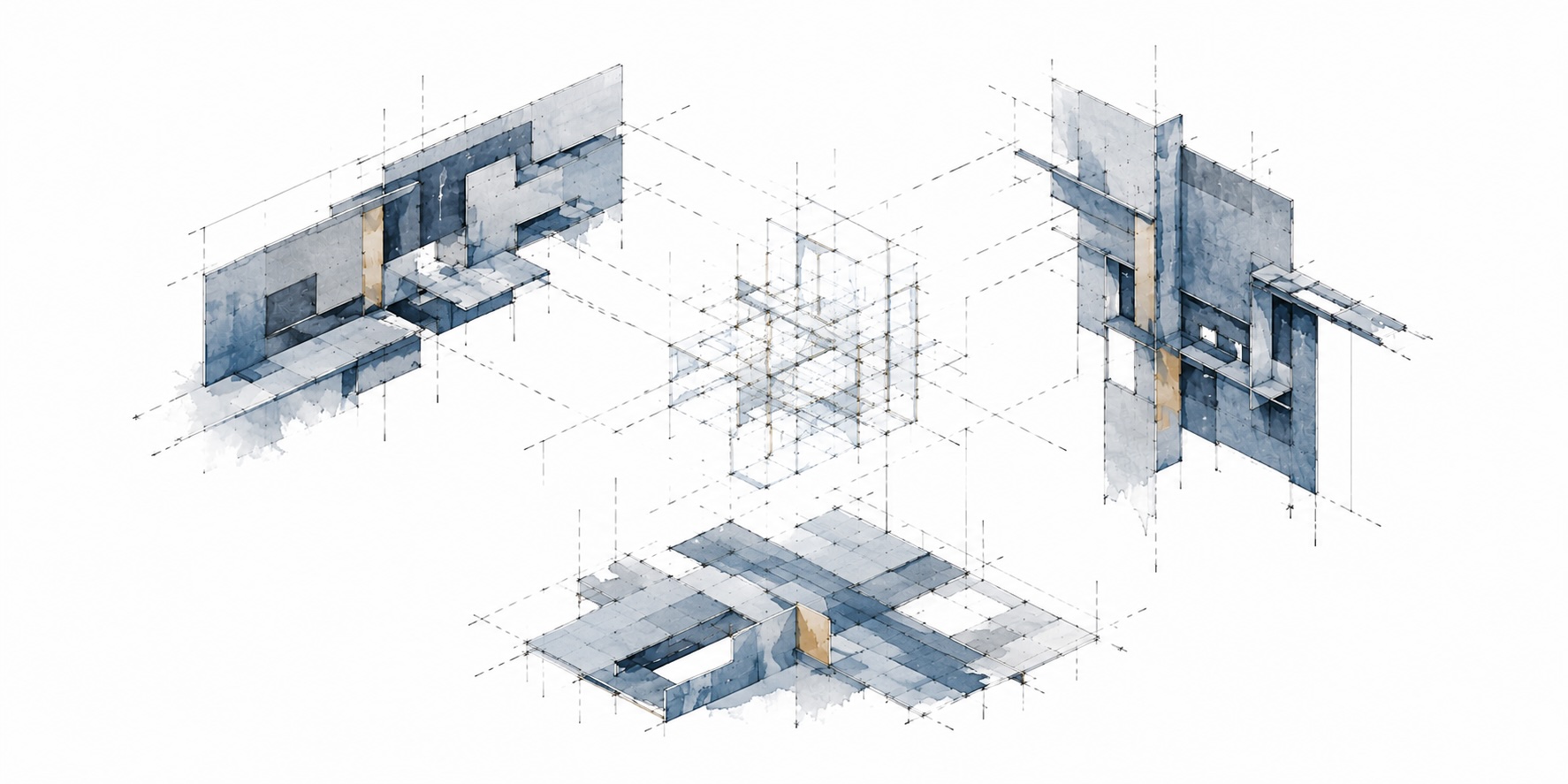
The purpose is not to formalize negotiations. Negotiation remains dependent on judgment, experience, and adaptation. The architecture provides methods to improve the quality and consistency of collective reasoning while leaving decisions and interaction with the people responsible for them.
On the AI side, this means designing systems that preserve context across the negotiation, distinguish evidence from interpretation, and make the evolving situation available for analysis and challenge. The AI architecture described here provides the technical structure for doing that.
On the human side, the same architecture has to be usable without turning negotiation into bureaucracy. The Negotiation Modules break the overall reasoning task into bounded questions that teams can work through selectively — making relevant context and assumptions explicit while preserving individual judgment and flexibility in the negotiation itself.
Where this matters
Not every negotiation requires the same degree of organizational capability. In routine, repeatable situations, experience, individual skill, and established processes may provide enough structure.
The value of Negotiation Architecture increases when negotiations are novel, multi-issue, multi-domain, or distributed across several functions and stakeholders. In these situations, established routines provide only part of the answer, while decisions in one area can change the options available elsewhere.
The risk is not complexity itself, but the quality and timing of the reasoning applied to it. Available facts, interests, constraints, or dependencies may enter too late. Options are developed against incomplete assumptions, priorities are set prematurely, and commitments narrow the room for later correction.
Better organizational reasoning moves consequential revision forward — while options are still open and the cost of change is lower. The result is better negotiation outcomes: fewer late corrections, fewer locally optimal decisions at the expense of the whole, and a better chance of identifying and preserving valuable options.